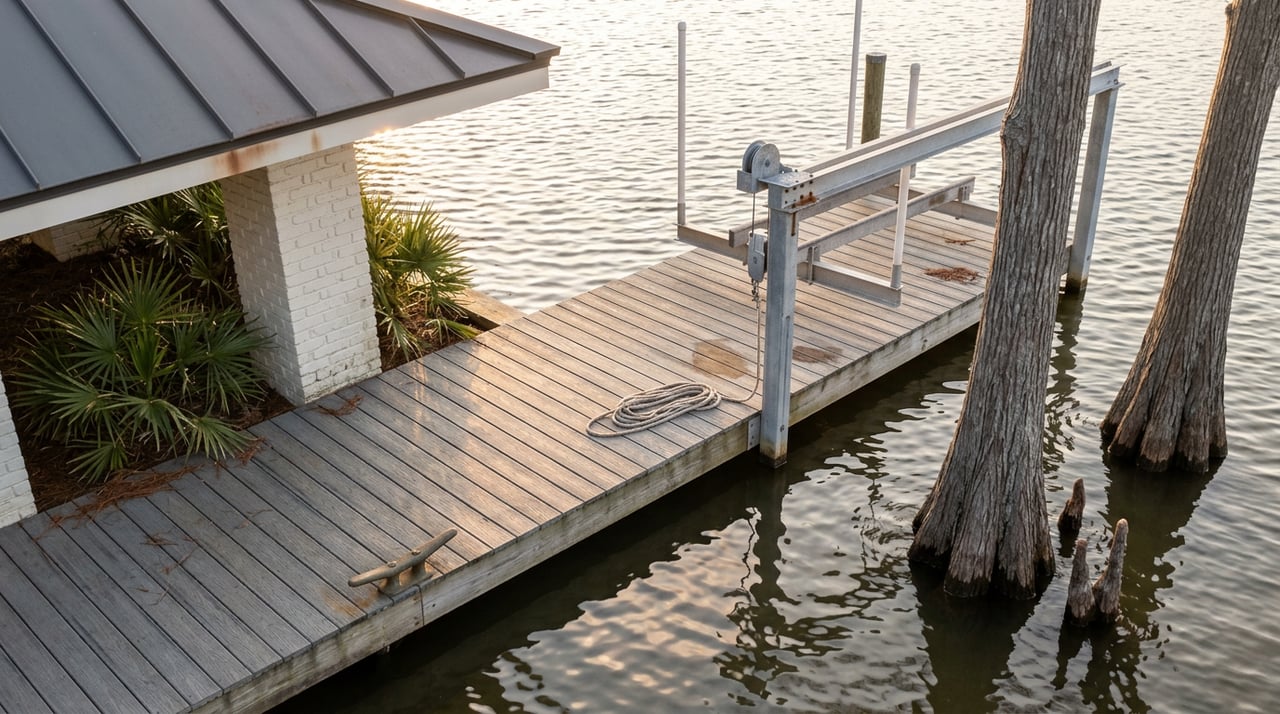
Scroll through waterfront listings on Bayou Pierre Part or Bayou Tranquille long enough and you will run into a phrase that sounds like a typo the first time you read it: so many feet of batture. One listing on Bayou Pierre Part advertises a spacious lot with roughly 160 feet of batture alongside a private boat ramp, bulkhead, and wharf. Most out-of-state buyers, and plenty of Louisiana ones, skim right past it. It reads like a measurement. It is actually a property law question, and in a town where nearly every desirable lot touches Lake Verret, Belle River, or one of the bayous that thread through it, that question shapes who can buy the property, how fast it sells, and what the buyer actually owns when the ink dries.
Here is the claim worth sitting with before you write an offer on anything with water in the description: the long days-on-market and the wide price spread you see in Pierre Part right now are not primarily about demand for lake views. They are about how few transactions can clear the twin hurdles of Louisiana's batture law and the way lenders classify the camps sitting on that land. Understand those two mechanisms and you understand why this market behaves the way it does.
What batture actually is
Louisiana runs on civil law, not the common law system most of the country uses, and nowhere does that show up more plainly than on the water. Batture is the land between the ordinary low water mark and the ordinary high water mark of a navigable river or bayou. It is not quite the riverbed, which belongs to the state, and it is not quite dry land, which belongs outright to whoever holds title. It sits in a legal middle zone that courts have spent close to two centuries defining case by case.
The part that catches buyers off guard is Louisiana Civil Code Article 501. It says that riparian landowners, meaning anyone whose property fronts a river or bayou, are entitled to equitable use of the batture in front of their land. A neighbor with less river frontage than you can, in some circumstances, go to court and ask for a different division of that batture than the one your property lines would suggest. One New Orleans real estate law firm that handles riparian title work put it plainly in a client guide on the subject: buyers who assume their batture simply extends their property lines straight out to the water are making an assumption the law does not automatically back up.
That is not a reason to avoid waterfront property in Pierre Part. It is a reason to treat the phrase "feet of batture" in a listing as a prompt to ask a question, not a number to skim past.
Why this bites harder here than in most towns
In a lot of markets, riparian law is a footnote that shows up once a decade in a dispute nobody in the office remembers. In Pierre Part it is closer to a daily fact of the business, because so much of the town's inventory sits directly on Lake Verret, Belle River, Bayou Pierre Part, or Bayou Tranquille. The town's whole identity, from the boat launches to the camps built for weekend fishing trips, runs on that shared water frontage. Nearly every listing worth touring during boating season has some batture question attached to it.
That is exactly why a current survey from a Louisiana-licensed surveyor matters more here than it would in a subdivision three miles inland. The survey is the only document that tells you, with any confidence, where your fast land ends and the batture begins, and whether a neighbor's frontage gives them a legal claim on part of what you thought you were buying outright.
The second friction: what's sitting on the land
Batture is one half of the story. The other half is what is built on the property, because a large share of Pierre Part's waterfront inventory is not a conventional stick-built house. It is a camp or a manufactured home, often elevated on piers or set on a slab, built for weekends on the water rather than year-round living in a subdivision.
That distinction matters enormously to a lender, because manufactured housing financing splits into two very different categories. If the home is titled as real property, meaning it is permanently affixed to land the borrower owns and the title has been retired accordingly, it can qualify for a conventional mortgage with a standard down payment and a normal 30-year term. If it is titled as chattel, meaning the home is treated as personal property separate from the land underneath it, the borrower is usually looking at a larger down payment, a shorter loan term, and a higher rate, if a lender will touch it at all.
That single classification question, decided years before the current owner ever listed the property, quietly determines whether a buyer can walk into a bank and get a normal mortgage or has to come with cash or find a specialty lender willing to underwrite chattel financing. It is rarely mentioned in the listing. It shows up during underwriting, sometimes after the buyer has already fallen in love with the dock and the water view.
What the numbers are actually telling you
Put those two frictions side by side with the market data and the pattern gets easier to read.
| Townwide (July 2026) | Waterfront segment (August 2026) | |
|---|---|---|
| Median price | $244,500 | $284,000 |
| Typical days on market | 118 days | 179 days |
| Price range | $122,100 to $1,500,000 | Concentrated at the upper half of that range |
A waterfront median roughly $40,000 above the townwide figure is not surprising on its own. Lake and bayou frontage commands a premium in most markets. What is worth noticing is the gap in days on market. Waterfront properties in Pierre Part are taking about 60 days longer to sell than the townwide average, and that gap lines up neatly with the two frictions above. Every waterfront transaction has to clear a batture question and, more often than not, a real-property-versus-chattel question, before it can close. Each of those questions narrows the pool of buyers and lenders willing to move forward on a given timeline. Fewer eligible buyers means longer time on market and a wider spread between what the cheapest and most expensive waterfront properties actually sell for, because cash buyers and buyers who qualify for conventional financing are working from very different playbooks.
That is the mechanism behind the number, not a story about softening demand for the lake.
What to do before you write an offer
If you are seriously looking at a waterfront property in Pierre Part, a few steps up front save real headaches later.
- Order a current survey before you get too far into the process. An old survey, or none at all, is how buyers end up surprised at the closing table.
- Ask directly whether the property's batture has ever been the subject of a dispute or an Article 501 claim from a neighboring riparian owner. Sellers and their agents should have this information or know where to find it.
- Confirm how the dwelling is titled with the Assumption Parish assessor's office and your lender before you get attached to a specific camp. Real property and chattel are financed on completely different terms, and finding out which one you are dealing with early changes how you shop.
- Build the 179-day waterfront timeline into your expectations from the start. It is not a warning sign about the property. It is the baseline for how long these deals typically take to clear title and financing questions.
None of this makes buying on the water in Pierre Part harder than it should be. It makes the process predictable instead of surprising, which is the whole point of doing the homework before you write the offer instead of during underwriting.
A few questions worth asking directly
Does every waterfront lot in Pierre Part have batture? Any lot fronting a navigable body of water, including Lake Verret, Belle River, and the bayous that run through town, will have some batture in front of it. The amount and its legal status vary lot by lot, which is exactly why a survey matters more than the number printed in the listing description.
Can a camp titled as chattel ever become real property? In some cases a homeowner can have the home permanently affixed and the title retired to convert it to real property, which then opens the door to conventional financing. It is a process worth discussing with a title company and lender rather than assuming, since requirements and paperwork vary by situation.
Does batture status affect flood insurance? Batture classification is a title and ownership question, separate from FEMA flood zone designation, which is what actually drives flood insurance requirements and cost. A property can have a straightforward batture situation and still sit in a high-risk flood zone, or the reverse, so the two should be checked independently.
Buying on the water in Pierre Part is still one of the more rewarding moves available in this part of Louisiana. It just rewards buyers who ask about the batture line and the title classification before they fall for the dock. Lori Broussard works with buyers across Pierre Part and the surrounding Acadiana communities and can walk you through exactly these questions on Lake Verret, Belle River, or wherever you're looking. If you are considering a waterfront property here, schedule a free consultation before you write the offer, not after.